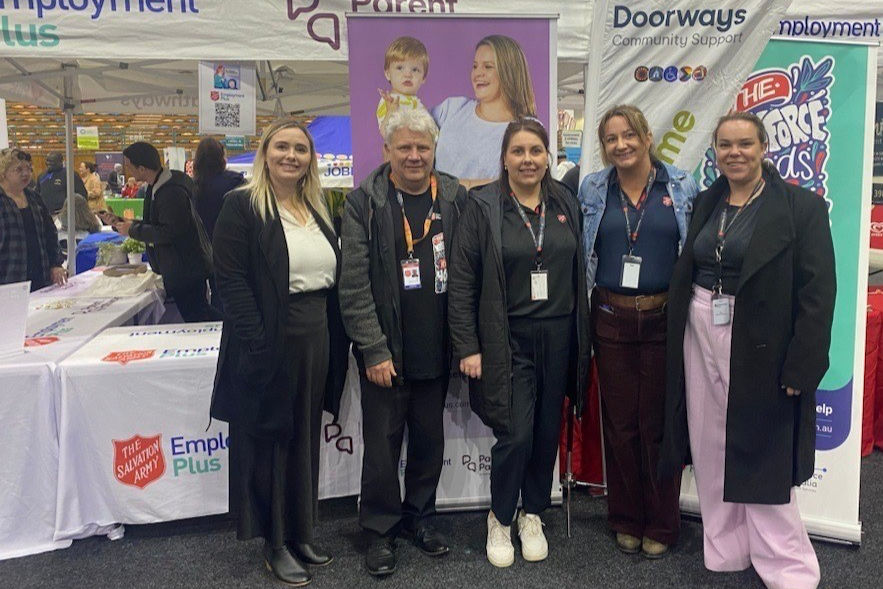
A day in the life of an Employment Plus consultant
Updated: Mar 10

It’s 8.30am. Another day, another dollar. For Employment Plus’s employment consultants across Australia, it’s all hands on deck and hearts full as they dive into the fast-paced mission of transforming lives through employment. In her ongoing series on The Salvation Army’s Employment Plus agency, Salvos Online journalist LERISSE SMITH catches up with several Employment Plus consultants to uncover what a typical day looks like – and the wins that make it all worthwhile.

Tiffnny O’Connor (Victoria)
What led you to become an employment consultant – and what keeps you excited about your work?
I’ve always wanted to work with people who are disadvantaged. When this job came up, I thought, why not? It’s something I always wanted to do. What keeps me excited is helping people. I love helping people, and to see some of my participants regain their independence and move away from their situation is really rewarding. It makes me want to get up every morning and come to work.
Walk us through a typical day – if such a thing even exists!
Generally, I have appointments back-to-back. So, having people come in, getting to know them and starting their journey with us. Everybody’s journey is slightly different. There’s also an incredible amount of paperwork, plus putting it all through the system and ticking all the boxes.
What’s a memorable or ‘wow’ moment you’ve had with a client?
I had a young man come in to see me. He had been jobless for about three years and was feeling very down. I very quickly got him into a job – and he’s been in that job ever since. I’ve just watched him grow from a person who was a bit introverted, a bit scared, to someone who is relatively confident and able to do his job. His employer is so happy with him. He keeps in touch with me regularly. I think that’s amazing, and to hear him say that his parents are proud of him – that’s a real wow moment!
What’s the most rewarding and challenging part of your role?
The most rewarding is seeing the participants come out of themselves and realise that there is a job out there for them. The most challenging is dealing with some participants who have very complicated mental health issues who become a little bit aggressive. It is quite challenging because that’s not something that I’m often used to.
How do The Salvation Army’s mission and values influence your everyday work?
Lots of people call me a Pollyanna! I’m always very positive. I value integrity. I always want to do my 110 per cent best. The Salvation Army’s values are very much aligned with what I believe in – compassion, understanding everybody, and giving them a chance to talk.
At the end of the day, what makes you feel like saying, ‘Yep, that was a good day!’
When I manage to get through all my appointments with everybody leaving happier than when they came into the office.

READ MORE: It’s more than a job for Graeme White
Patricia Adorini (NSW)
What led you to become an employment consultant – and what keeps you excited about your work?
After 25 years in nursing, working closely with what was then the Department of Community Services, Allied Health at Hawkesbury Hospital, the United States National Guard, and the RAAF in the same role, it was time for a career change. A friend suggested I apply for an employment consultant position with Match Works in Blacktown (Sydney). It involved face-to-face interaction, and many of my existing skills matched the job criteria. I was successful and have never looked back. I get excited when faced with challenging situations that allow me to apply my life skills to change participants’ lives. As the Mental Health and First Aider, I regularly use these skills. It’s extremely satisfying to help participants through employment, boost their self-esteem, or support them in domestic violence situations by liaising with our community services. Seeing them progress and recover is incredibly rewarding. I’m grateful to be in this role – and proud of my achievements.
Walk us through a typical day – if such a thing even exists!
No day is the same. I arrive early, print work calendars, read files, check notes and action plans, and follow up with clients. Remembering previous conversations and addressing ongoing issues earns clients’ respect because it shows I understand their situation. Delivering results is what makes me happy.
What’s a memorable or ‘wow’ moment you’ve had with a client?
A young Indigenous woman, who had never worked and was couch-surfing, was initially rude and inappropriate. But she took a factory job, and the following week, hugged me tightly, thanked me, cried, and apologised for her behaviour, saying, “You’ve changed my life.” That moment touched my heart and taught me the meaning of what we do.
What’s the most rewarding and challenging part of your role?
The most challenging clients are those recently released from jail – they are extremely vulnerable. Gaining their trust and saying, “We’re going to get there, and around this barrier”, is crucial. The most rewarding part is achieving results. Helping someone others may have given up on and seeing them move forward means the world to me.
How do The Salvation Army’s mission and values influence your work?
It’s about showing respect, regardless of a person’s past, treating everyone individually without judgment, and letting them know I genuinely want to help.
At the end of the day, what makes you feel like saying, ‘Yep, that was a good day!’
It’s results. When someone says, “Hey Tricia, I’ve got an interview!” ... that, to me, means the world.

Rashidah Perrins (Victoria)
What led you to become an employment consultant – and what keeps you excited about your work?
I applied during lockdown after being made redundant. With a background in government roles in London and 10 years in retail in Australia, the role sounded perfect. What keeps me excited is being able to help, and that four years on, the role keeps changing. It’s multi-faceted, different each day, and I get to meet people from all over the world. It’s amazing! It keeps me on my toes as the demand in society changes.
Walk us through a typical day – if such a thing even exists!
I work across two sites – Heidelberg and Preston. Mornings will start with reviewing my caseload, phone and face-to-face appointments. I have regulars from the local community mall and centre come in and say hello. There’s also face-to-face contact, but I’m usually on the phone, working through daily checklists and reaching out to employers. We often walk through Heidelberg’s mall and centre as it’s a key community hub.
What’s a memorable or ‘wow’ moment you’ve had with a client?
I supported a 57-year-old CALD unemployed grandmother who had language barriers and struggles with age discrimination. We completed her resume on a Friday, called employers on Monday, and by the following Friday, she was placed with a local employer who just wanted someone to work. She’s still there two years on. That was a ‘wow’ moment. It doesn’t usually happen that fast!
What’s the most rewarding and challenging part of your role?
Meeting clients’ needs in any capacity is most rewarding – a phone call, someone to speak to. Often, I will be thanked for being a listening ear, someone to talk through problems, or just helping in any shape or form. Challenges include demands in society, cost-of-living pressures, mental health support, and an increase in long-term unemployed and required support services.
How do The Salvation Army’s mission and values influence your everyday work?
The Salvos’ mission and values are my core mission and values – caring for people, providing support, compassion, and having a diverse community base. It naturally aligns.
At the end of the day, what makes you feel like saying, ‘Yep, that was a good day!’
When a client says, “Ah, that makes me feel better” or “I’m so glad I spoke to you.” It could also be anything such as “Thankyou for picking up my call”, “Thanks for helping me with my resume”, “Thanks for changing my appointment time.” It’s the feeling we helped someone.

READ MORE: Transforming lives in Sydney’s north
Kirra Goodwin (NSW)
What led you to become an employment consultant – and what keeps you excited about your work? After 14 years as a bar manager, I developed skills in leadership, problem-solving, and interpersonal skills working with diverse people. Becoming a single mom necessitated me to seek more stable, secure employment to support my son. My passion for helping others led me to become an employment consultant, which I find incredibly rewarding, especially guiding people through their employment journey. The impact we make on their lives – big or small – is what keeps me excited.
Walk us through a typical day – if such a thing exists!
Checking emails, completing daily tasks, connecting with employers for potential job opportunities, client meetings, assistance with resume creation, course enrolment, and job referrals. I also check in on their employment progress. There is a lot of administrative stuff that needs doing, from updating privacy forms, taking notes, to tracking participants’ progress. It’s a fast-paced role.
What’s a memorable or ‘wow’ moment you’ve had with a client?
One memorable moment was with a client who had Complex Post-Traumatic Stress Disorder (CPTSD). I arranged allied health support for him, and after several sessions, he started his own consulting company the day before he turned 67 and exited to the aged pension. Months later, he called to let me know his business was thriving, and the allied health assistance changed his life.
What’s the most rewarding and challenging part of your role?
The most rewarding part is seeing the change in someone’s confidence from when they attend their first appointment to when they secure a job. The most challenging part is supporting people who have complex barriers to employment and finding ways to help them overcome them.
How do The Salvation Army’s missions and values influence your everyday work?
Integrity shapes how I make decisions, handle confidential information, and remain accountable and transparent in my responsibilities. Compassion influences how I treat every person with patience and understanding, recognising that many may be facing big barriers. Respect reminds me to treat everyone with kindness, irrespective of their circumstances. Diversity encourages me to embrace differences in culture and lived experience, and to create a welcoming, safe environment.
At the end of the day, what makes you feel like saying, ‘Yep, that was a good day!’
A good day isn’t always about big outcomes. If I’ve helped someone move one step closer to their goal or helped remove a barrier that was holding them back, that’s when I think, yep, that was a good day.

READ MORE: Addressing challenges in NSW Hunter region