
Are your hands clean?
CAPTAIN DR JOHN CLIFTON*
She went from person to person, standing before them, and asking. Palms open.
Kings Cross Station. Everyone looking upwards at the board, waiting for platform details. It’s a static audience. No harm in asking.
Now she came to me. I smiled and took out my headphones. I’d been prepared to say my usual line: sorry, I don’t have any cash but I can buy you food or drink if you’re needing something.
But the hands weren’t outstretched. Instead, she said:
“Can I have a Percy Pig?”
She’d spotted it. I had a bag of Percy Pigs in my coat pocket and was working my way through them one by one.
“I saw you had some.”

She noticed things.
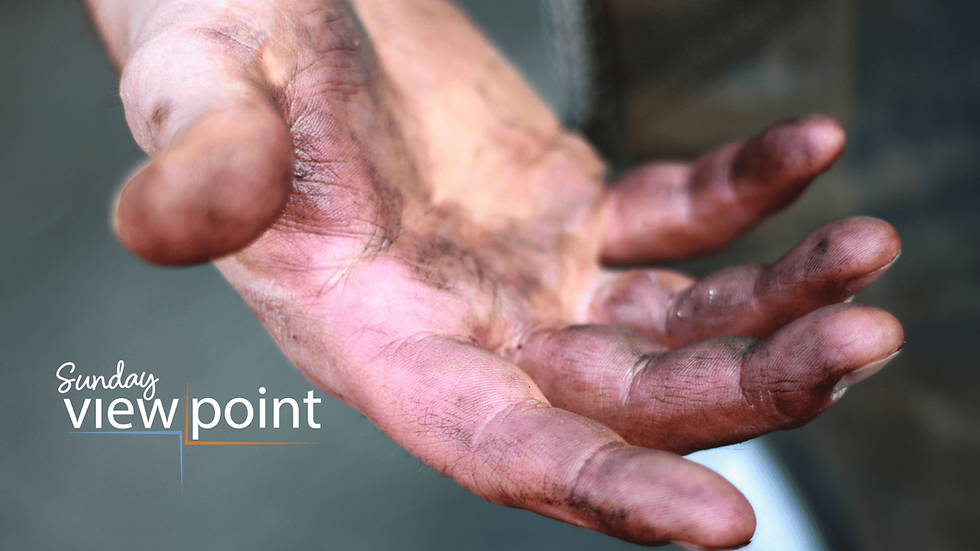
I pulled the packet out so she could take one herself. Now she showed me her hands, dirty with grime worked into the crevices. It was clear she didn’t think it right to reach into the packet. So, I took a few sweets out and placed them in her hand.
She turned to go. Then she stopped, turned back, and asked:
“Are your hands clean?”
I admitted they were about as clean as you’d expect from someone out and about all day. She nodded and walked away, disappearing back into her pattern of working through the travellers.
Afterwards, I realised I should probably have shaken some out of the packet instead of touching them myself. Better manners. Better hygiene. I regretted it slightly. It wasn’t intended.
The question hit me deeper.
Are your hands clean?
This is obviously a biblical, and a moral question. As it says in Psalm 24:3-6 (NRSV):
“Who shall ascend the hill of the Lord?
And who shall stand in his holy place?
Those who have clean hands and pure hearts,
who do not lift up their souls to what is false
and do not swear deceitfully.
They will receive blessing from the Lord
and vindication from the God of their salvation.
Such is the company of those who seek him,
who seek the face of the God of Jacob.”
Psalm 24 challenges those approaching the presence of God. It is a liturgical question asked at the threshold, naming the kind of life that can stand before holiness without pretense.
In his 1948 play Dirty Hands, Jean-Paul Sartre exposes the moral ambiguity of action in the real world: that to take action at all, let alone decisively, is to risk contamination, and that clean hands may only be preserved by refusing to act at all. One character, Community Party boss Hoederer, sneers at the very idea of innocence, insisting that anyone serious about change must accept dirty hands as the price of engagement:
“How you cling to your purity, young man! How afraid you are to soil your hands! All right, stay pure! What good will it do? … Well, I have dirty hands. Right up to the elbows. I’ve plunged them in filth and blood. But what do you hope? Do you think you can govern innocently?”
Sartre’s question is whether anyone who truly engages the world can remain pure.
In response to Sartre, Albert Camus wrote The Just Assassins (1949). There, he dramatises the story of a real group of Russian revolutionaries / terrorists who were plotting the assasination of the Grand Duke. Camus explores the question of how far action may go without destroying the very values it claims to serve. In the play, the character Kaliayev eventually carries out the assassination, having delayed when children were present. After this, he accepts responsibility, refuses to flee, and goes to his execution without appealing to necessity or history to absolve him. His posture is simply to remain answerable for his actions.
Camus agreed with Sartre on one point: withdrawal from the world is not an option. But he rejected Sartre’s deeper move, which was the absolution of violence by historical necessity. Guilt, Camus insists, must remain guilt, and never be normalised. His position is that action may be necessary; violence is tragic rather than avoidable; and those taking action must never claim moral triumph, inevitability, or innocence.
Psalm 24 presses a different logic again. Unlike Sartre’s realism or Camus’ tragic restraint, it neither denies the cost of action nor normalises contamination as inevitable. It asks instead whether hands shaped by action can remain truthful before God. Hoederer plunges his hands into filth and blood and calls it realism. The Christian claim is that such hands may yet be washed, not into innocence, but into truth, by the blood of Christ.
Standing there, munching another Percy Pig, I felt the tension of the question:
Are your hands clean?
An exchange. A handful of sweets. An unexpected question from an unexpected person.
Holiness has a way of finding us – nearly always with dirty hands, often inconvenient, and sometimes through voices we were not listening for.
*Captain Dr John Clifton is Divisional Commander for the North East Division of The Salvation Army UK. He writes on Substack about Salvationism and faith. This article first appeared here and has been reprinted with permission.


