
Glimpses of a nation at war: Part 2
Updated: Jun 11

Salvos Online journalist SIMONE WORTHING and her husband Cliff have recently returned from a deployment with International Headquarters Emergency Services, assisting at various corps in the Ukraine Division of the Eastern Europe Territory. Simone wrote this report, providing a snapshot of the work of The Salvation Army, the people impacted, and some personal reflections.
Content warning: This story contains descriptions of grief, loss and war. Please read at your discretion.
“Thank you, Salvation Army Australia, for praying for us in Ukraine, for our country, for coming to be with us and for not forgetting about what we are facing. This gives us such comfort, such strength, such hope. We are struggling, but we are not forgotten, and people around the world are joining us in prayer – even in faraway Australia. We value this more than words can say. It means so much. We are not alone.”
We heard this and similar comments so many times throughout our recent, almost four weeks in Ukraine. The gratitude of the people was so humbling, but also inspiring and encouraging. We also assured them that we had learned more from them than we could possibly give back, as we witnessed deep faith and a commitment to worship, service and ministry in a country at war.
Focus on children
The Salvation Army across Ukraine has a special focus on children. Each of the seven corps and one outpost runs an after-school program for primary-aged children, providing help with homework, extra educational and fun activities, a hot meal, time with a psychologist, and a caring, supportive atmosphere. The children, most of whom are internally displaced due to the war or come from poor and vulnerable families, thrive in this environment. The sound of their laughter and the buzz of their energy and enthusiasm bring joy and hope in extremely challenging times.
“My son had stopped talking after we fled the fighting early in the war,” shared Tanya*. “He saw such atrocities and simply shut down. After a few weeks in the after-school program, he gradually started to play again and show interest in activities. After a couple of months, he started to smile. Now he is talking again, playing and engaging with other kids. I just cannot believe it, and I am so grateful.”
A staff member from one of the corps spoke about the program’s wider impact. “The children are happy, which helps the families, which helps the community,” she said. “And our team, we support each other in our personal lives too, and the officers help us as well. It’s like a family, which we all need in these hard times.”
The corps also runs youth groups and Scouts, which are popular with children and young people from both the corps and surrounding communities.
War’s impact on children
Tragically, though, in times of war, these activities – and life in general – are often disrupted.
“We recently took the children out for a (northern) summer play in the park, drawing with chalk on the asphalt paths,” said one corps leader in Eastern Ukraine. “Unfortunately, once again, the arrival of rockets and Shaheds [Russian kamikaze drones] did not allow their fun and creativity to continue. May the Lord keep us all under his holy protection.”
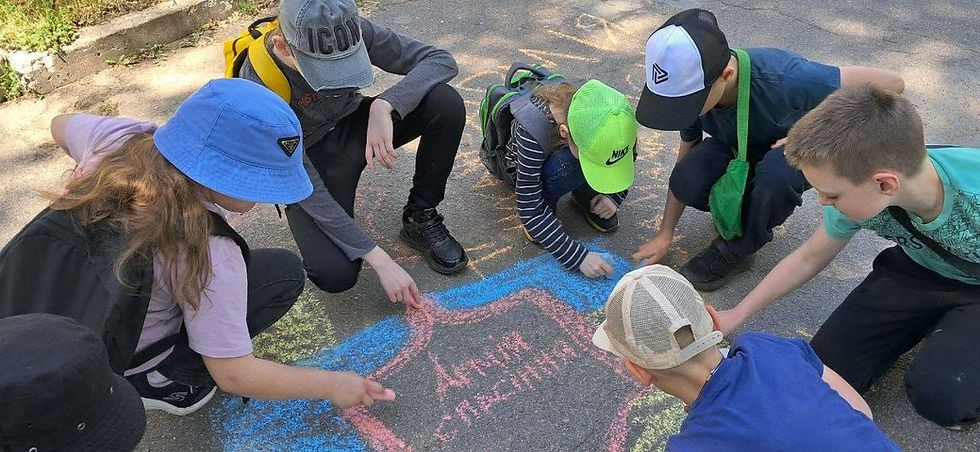
Eight-year-old Ilya and his family fled the Donetsk region just after the full-scale war began in February 2022, witnessing death and destruction on a large scale as they escaped. They now live in Central Ukraine and attend the local corps. Ilya had his birthday party online recently so he could share it with his friends, who are also displaced from the temporarily occupied territories and living in different regions. “My birthday wish for all of you is that you will never know what it’s like to be shot at, or to see people being shot,” he told his friends.
One lady who regularly attends corps programs shared that her children are still scared by their early experiences of war when they lived closer to the frontline. “Now, even when there are no air raid sirens, they want to sleep in the hallway on their bedding. They don’t sleep on their beds anymore.” (If people can’t get to a bomb shelter quickly and easily, they often find a hallway within their flat, apartment block or house that has an extra wall between them and any windows. This is considered safer. As is the bathroom. Many say wryly that nothing will save them from a direct hit from a missile, but they do what they can).
Due to their proximity to the Russian border, cities and villages in Eastern Ukraine have endured constant Russian attacks since the first day of the full-scale invasion (24 February 2022). Russian forces regularly strike the area with artillery, kamikaze drones and guided aerial bombs, targeting homes and civilian infrastructure. Residents try to live their lives but are constantly on alert. Levels of sleeping disorders, stress and trauma are high.
“The toll on children, teenagers and adults is immense,” shared one corps officer. “For many of the children, the only thing they can remember in their short lives is war, particularly those living in the temporarily occupied territories. Tragically, we have got used to bombings, missiles and drones. It’s not good, we know that, but it’s our reality.”
The women who wait
Everywhere we went, we spoke to so many women, of all ages, waiting for their husbands, sons, grandsons, other relatives and friends to return from the front. Fear, worry, tension and hope were etched into their faces.
“I am from Kherson,” said Antonina, after a corps program in Western Ukraine. “My son is a medic in the Army, not far from the frontline. We worry when we don’t hear from him, but he calls when he can. If it’s been a while, I feel such anxiety, such fear. The Russians took my home, lived in it for a while, and then destroyed all of it. Both floors of our little home, our garden. I feel such pain when I think of it, I simply can’t tell you …” She started to cry and walked away.
“My grandson is 16 and is stuck in the temporarily occupied territories,” a worried grandmother shared. “We are trying to get him out, but it’s very difficult and expensive. It’s hard to talk to him, too. The connection is very bad, and apps have been blocked. I feel so helpless, but we will never give up trying.”
Oxana’s husband is in the military. He is not at the frontline but often travels into ‘hot spots’. She looks after their young family and works full-time. “I worry about him all the time,” she says. “I worry that he will be sent to the front, that something terrible will happen to him, and we will never see him again.”
Another corps member shared that her son is fighting at the front, but she doesn’t always know where. “He can’t tell me where he is when he calls,” she said. “I am just glad to hear his voice and pray God will bring him home.”
The pain of loss
Heartbreakingly, though, so many no longer wait. They know what has happened to their loved ones, and their intense grief is overwhelming.
“My grandson was killed in the war,” one woman told us. “My focus now is on helping my daughter through this grief and pain. He was such a good boy, and now he is gone.”
Another elderly lady, through sobs and regular pauses, shared about the deaths of her husband and then her nephew. “The pain is so intense, it just takes my breath away,” she said, in barely a whisper. “Our whole country is suffering like this. I just have to get through each day. I don’t want to, but I know I have to, and my husband would want me to. Thank God I can come to the corps. There are no solutions, but I get a moment of peace here.”
The evidence of the thousands who have been killed is everywhere. In the centre of Kyiv, just below the Mother of Ukraine statue on Independence Square (Maidan), thousands of blue-and-yellow Ukrainian flags line the pathways of one side of the square, with photos of so many young men and women alongside them. Beloved trinkets or candles adorn many of these tributes. People walk around them silently, hands on hearts, heads bowed, many in tears.

We saw these collections of flags and photos in many squares in towns and cities across the country. They also line the streets of many little villages – one tiny village we drove through, which consisted of only a few streets of houses, had hundreds of flags on display. The heavy sadness in the air was palpable, and our travelling group was silent as we passed through.
On the other side of the village, fields of bright, yellow canola (rapeseed) stretch for kilometres, and golden-domed churches glitter in the sun. The contrast is almost surreal.
Cities, towns and villages across the country remember and honour the fallen.
Never forgotten
Every morning at 9am, the entire country stops for a minute of silence to remember those killed fighting for Ukraine. People stand, mostly with heads bowed, wherever they are. Shop staff often come onto the streets. Cars stop, and many drivers get out – we saw quite a few go down on one knee in respect. In smaller towns, traffic is halted, and loudspeakers broadcast a message of respect and honour, or sometimes just a quiet tick, tick, tick.
If we were travelling by car, Major Konstantyn Shvab, Ukraine Divisional Commander, would stop the car wherever we were, pulling over if he could, or simply joining others who had turned on their hazard lights.
He explained that at the beginning of the full-scale invasion, few people observed the Minute of Silence. “As the war dragged on, though, and more and more people were killed, it became more important to observe,” he shared. “And now it’s huge. And everyone also knows and celebrates all the national Ukrainian days.”
Most of the country stops for the Minute of Silence every day at 9am.
War is everywhere
In cities, towns and villages in Central and Western Ukraine, far from the frontline, war is still ever-present. Tragically, Kyiv regularly experiences missile, drone and bomb attacks, with dozens killed and injured every month. And even in places where attacks happen less often, nowhere is exempt, and nowhere is really safe.
Across the country, there are reminders of war – bombed-out buildings, monuments protected by scaffolding and cathedral windows boarded up. People cast anxious glances at the sky and startle at loud noises. Billboards share the stories of fallen soldiers. Trenches and varying degrees of fortifications are present in many parks, and generators of all sizes are common sights on the streets and inside buildings.
Evidence of war is everywhere, even far from the frontline. Nowhere is totally safe.
Through the generosity of international Salvation Army project funding, each corps has a generator, ready for the frequent power outages, so ministry can continue. And Salvation Army ministry does continue – worship, programs and outreach – with so much of its response geared to those impacted by the war – which is almost everyone.
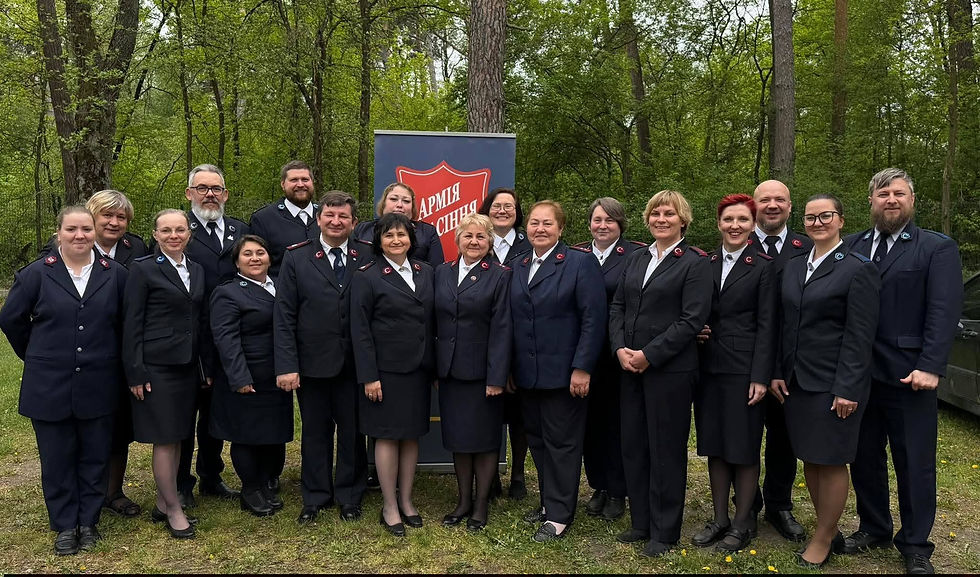
The female officers can leave the country at any time, but they have chosen not to. Rather, they stay and serve their corps and communities, standing alongside them during these dark and difficult days. Officers, employees and volunteers help encourage and support others, providing physical, emotional and spiritual care to so many in times of grief, uncertainty and exhaustion. This happens all over the country, including in regions close to the frontline.
Life goes on
In many ways, life does continue – it has to – but for most people, it is anything but normal. Just under the surface of laughter, celebrations, and the everyday is a tension, an uncertainty, and a weariness borne of more than four years of war. There is strength, determination, hope and commitment, but there is also grief, sadness and a deep desire for the war to just be over.
As one senior soldier of a corps said, “I know we have hope, and I trust in God, but I am so tired. I just want the war to be over and Jesus to return.”

*Names and locations have been changed


