
Looking back at ‘Salvo!’, the book launched by Bob Hawke
Updated: Jun 19

BY BARRY GITTINS
In 1993, Salvationist and journalist John Cleary published a 160-page coffee-table book titled Salvo!, launched by then-Prime Minister of Australia, Bob Hawke.
I suggest that the prolific and social change in those decades, occurring at such a frantic, continuous rate, makes the tome even more relevant for Salvationists in our present age, as a signpost and reminder of where we have recently come from.
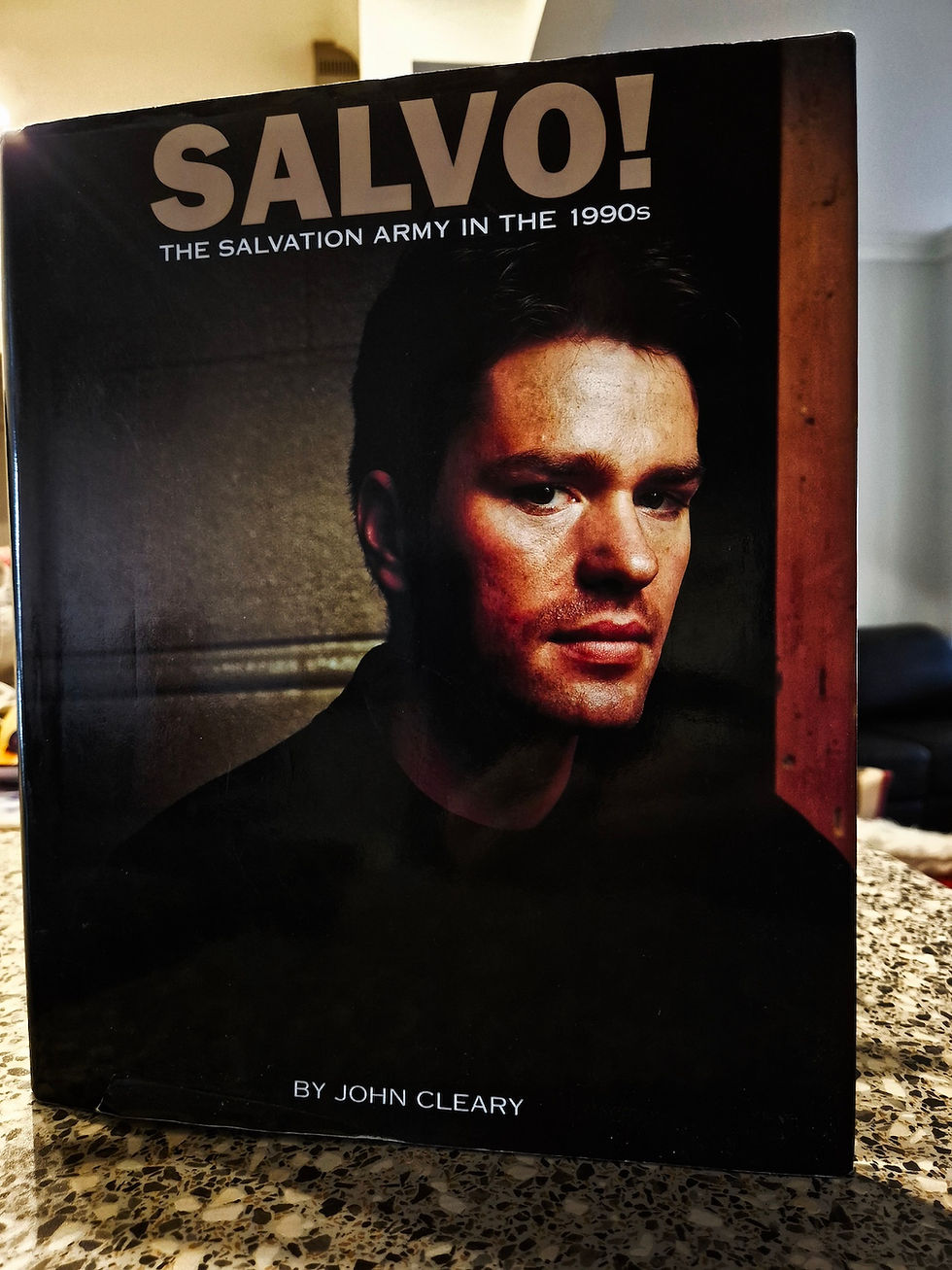
The first book to address the Army’s history since Barbara Bolton’s Booth’s Drum in 1980, Salvo! also included accounts of compelling profiles of Salvationists such as Ron Prussing, John Dalziel, Commissioners Leslie Rusher and James Condon, Lieut-Colonel Lucille Turfrey, Majors David Eldridge, Brian Watters and Errol Woodbury, and Wendy Gale. The list of people featured and their stories is a means of grace.
A Salvationist himself, John Cleary was a soldier at Sydney Congress Hall when he wrote the book.
The book’s subtitle, The Salvation Army in the 1990s, set a tone for its use as an examination of the movement at that time, as the book gave an eloquent explanation of our roots to readers ‘internal’ and ‘external’ – indeed, as well as a resource for Salvationists, the tome was and is a helpful public relations tool with a national focus. This was a significant achievement, as it was written at a time when there were two very distinct, separate Salvation Army territories in the country.
Citing Founder William Booth’s description of the need for a society to care for all of its citizens, having through injustice and inequity “greased the slope down which these poor souls slide to perdition”, Cleary included the many and varied paths through which the Army worked with practical compassion at that time, including homelessness services and counselling, corps, employment services, rehabilitation, reaching out to sex workers, emergency services, international aid, heath care, aged care, etc.

While church attendance and influence within Australia continue to decline, and evangelical Christianity has, in some circumstances and to some extent, been associated with politics and the ‘prosperity gospel’, this book reminds us of Booth’s selfless, sacrificial gospel.
William Booth, we are reminded, encouraged his troops to embody and share the message and person of Christ in our daily lives, actions and conversations, with integrity, humility, joy and hope.
An inspiring, inspired book that continues to have much to offer, Salvo! is well worth a read if you pick it up. It reflects William Booth’s belief that God wants to save the whole person, and that the Army is at its best when it sees all people as beloved by God, who, as the book cites Booth as saying, made us all with “a spark of God” within us.
READ MORE: To read Bob Hawke’s speech at the book launch, click here
John Cleary recalls writing Salvo!
The prompt to write the book came from Phil Wilson, who was a soldier with me at Sydney Congress Hall and was employed by The Salvation Army’s Public Relations department.
Phil was a recent immigrant from the United Kingdom and a former bandsman at Enfield, one of London’s best bands.
He brought a sensible and independent view of the Army in Australia; he had no stake in any of the petty politics that can bedevil such projects, and he was very keen for it to be a reflection of both territories.

It was fortunate that there was a publisher in Sydney, Focus Books, who had done some work with the Army; they were prepared to leave most of the editorial judgement to Phil and I, just making a few editorial observations as each chapter was prepared. I really felt little or no pressure from Focus or the Army in writing the manuscript. All the way through, Phil was my closest collaborator.
The timeframe was less than a year, but I cannot recall exactly. I did it whilst maintaining my full-time job at the ABC. As I had just ended a period as the staff-elected Director on the ABC Board of Directors (1988-92), the book was something of a fresh project, but with the advantage of having spent a few years looking at an organisation from the top down, rather than the bottom up.
The other advantage, from an ABC journalistic perspective, was that I approached the book with a non-Salvo audience in mind, giving them some sort of access through both history and personal experience of being ‘a Salvo’.
The plan of the book was that each chapter would be roughly structured with two strands: 1. History, 2. Personal experience. As you read each chapter as a personal story, you are also taken to the history and structure of a related element of Salvationist mission. Hopefully, that way you would end up understanding the Salvation Army, both historically and missionally.
The underlying hope, for me, was that Salvationists and others would gain some appreciation of the continued relevance of Booth’s insights regarding the Army’s dual mission, linking social and evangelical concerns, into organised, incarnational, world-redeeming action.
In due course, the Salvation Army Australia Museum sites at Auburn, NSW, and Melbourne, will have a limited number of free copies of Salvo! available to museum visitors at their request.


