
Tara's 'priceless' journey to wellbeing
BY KIRRALEE NICOLLE
When Tara Baggendorf first entered the Aboriginal Drug and Alcohol Council (ADAC) rehabilitation facility in Whitmore Square, Adelaide just under two years ago, she had very little understanding of how addiction could appear in its various forms. As someone who was experiencing alcohol addiction and who had grown up with a mother who faced alcoholism, she hadn’t seen much of the impact of drug addiction.
“That’s very different,” she said. “It's also a part of life I didn't really have much of an understanding [about], and I think the withdrawal is very different. So, when you've got people [experiencing] different withdrawals in such a small place, that was also very eye-opening.”
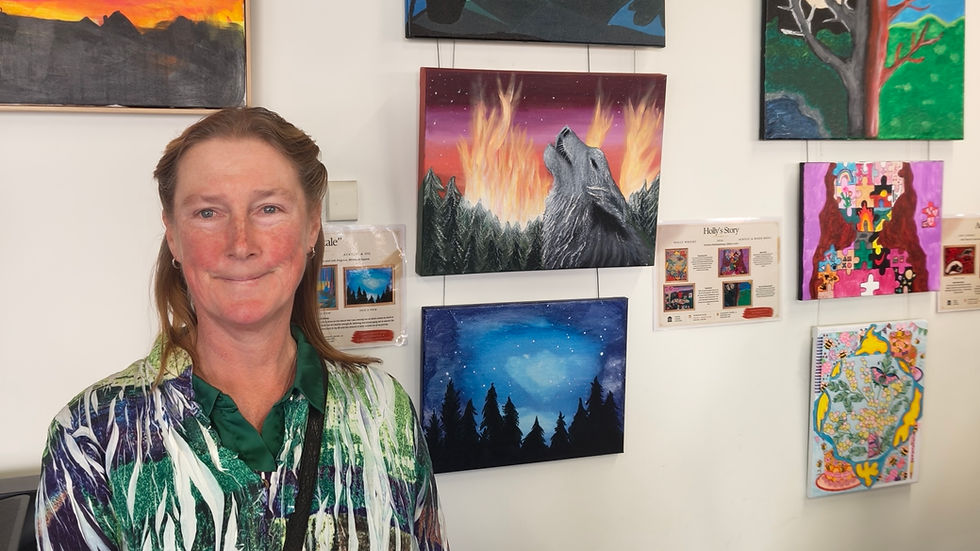
Not only were Tara’s eyes opened, but she experienced a new kind of grief through watching the journeys of others. I got to hear some of her story at an art exhibition in Adelaide CBD featuring work of Tara and other TSA clients. The ADAC centre is connected to The Salvation Army’s Warrondi Engage and Link (WEL) Day program.
“I lost the only person that I got close to in rehab very shortly after she got out,” Tara said. “To bury her was big. She was also an incredibly artistic person. She would love to have been here today.”

Outside of rehabilitation, Tara runs a thriving olive and pistachio farm in Port Wakefield, SA. Having spent a lot of her life on the land, she describes herself as outdoorsy and a hard worker. Along with that lifestyle, though, and a history of alcoholism in her family line, she found as she approached her 50s – the decade in which her mother died of alcoholism – that she was drinking much more than she wanted to be. She developed pancreatitis and realised her muscle tone and general health were suffering. Tara also felt that she wasn’t being present for her adult daughter like she wanted to be. Alcohol was taking over her life.
After a consultation with a general practitioner and then a drug and alcohol worker, she was referred to ADAC, where she then stayed for three months. There, through the WEL Day program, for the first time she discovered gym and weights training, which helped her to improve her muscle mass. She also discovered art.
“You just wouldn't believe how much you look forward to cooking and art and gym [when in rehab],” she said. “I'd never been to a gym in my life, and I'd never painted in my life. And when I first went into rehab, I just did colouring-in and I made cards for people, and I'd never painted until [WEL program art teacher Leah Jeffries] said, ‘Why don't you try painting?’ And I thought, ‘Well, why not?’
“I didn't have much to lose. Leah is an amazing art teacher, and she is very encouraging.”

Tara began with acrylics, painting outdoor scenes, including the cover of a Stephen King novel. Then, she moved onto oils and began painting small canvases as gifts rather than giving birthday cards.
“I just find it a really personal and therapeutic way to express myself,” she said.
At the art exhibition, Tara stood in front of the crowd and explained the story behind her work, telling how the WEL program art classes had made a profound difference to her life amid a difficult time.
But it hasn’t all been easy. Since leaving the ADAC facility, Tara has had many ups and downs, including times she said she found herself at “rock bottom”.
“While I was in rehab, everyone's going, ‘Oh, you must be so excited. It's time to get out. It's like getting out of jail.’ And I knew that my biggest challenge was when I got home. My husband's a fairly heavy drinker, so I'm still [surrounded by] alcohol. I knew I had to go back into an environment which is probably harder,” she said. “The whole 19 years of our relationship up until then had been with both of us drinking, so I knew that that was going to be a big challenge.”
The paintings Tara has done since leaving ADAC. Images: Supplied
But despite the challenges, Tara has worked through them, alongside her ADAC and WEL program case workers and art teacher Leah. She now has a thriving relationship with her daughter, and her health has improved. She still regularly attends art classes, and stays connected to the gym and other programs offered in Whitmore Square.
“I just love that that support is still there,” she said. “I can still go back and do any of the art or speak to them, and that is priceless.
“To feel good within myself, mentally and physically, is absolutely amazing.”


